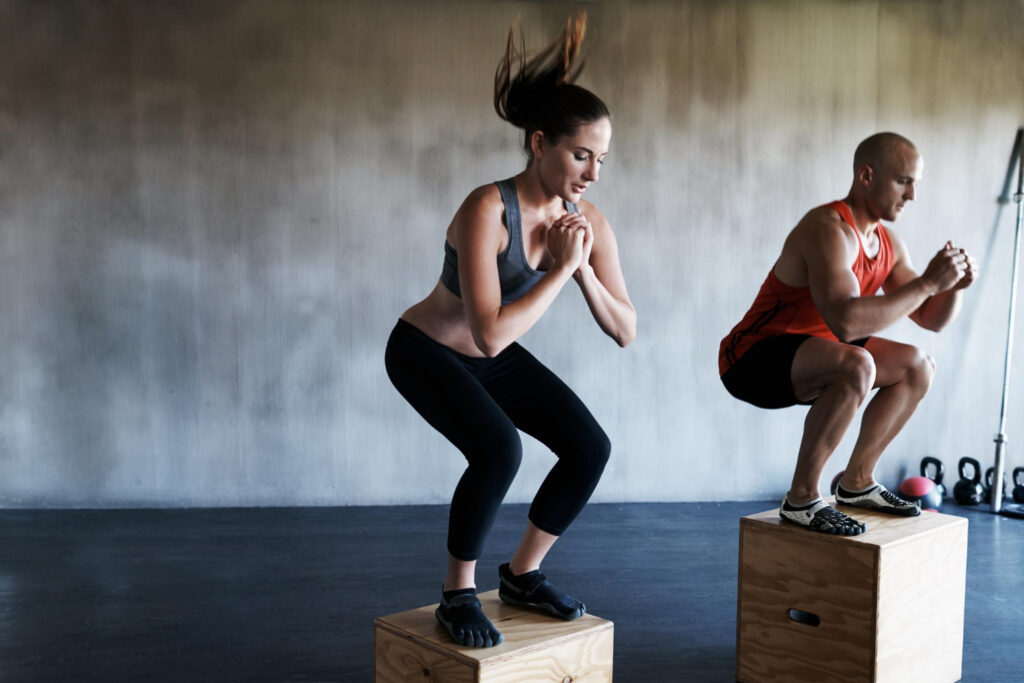

If you spent hours playing elastics or hopscotch as a child, we have some news: you are already familiar with the basics of plyometrics ;)
Of course, back then no one thought about running economy, Achilles tendons, or the stretch-shortening cycle of muscles. But many popular children’s games worked according to exactly the same principle that athletes today deliberately use to develop speed, strength, and coordination.
So, What Exactly Is Plyometrics?
Plyometrics is a set of explosive exercises (that is, exercises that require maximum force in the minimum amount of time) in which a muscle is rapidly stretched and then almost immediately contracts.
As a separate training method, plyometrics developed in the second half of the 20th century. Its development is associated with Soviet sports scientist Yuri Verkhoshansky, who studied ways to increase explosive strength in track and field athletes. He was the one who pioneered the so-called “shock method” of training, which involved a rapid transition from landing to take-off.
Later, these principles attracted the attention of coaches in the United States and Western Europe, and the term plyometrics entered sports science and became the generally accepted name for explosive jumping exercises. Today, plyometrics is used all over the world in the training of sprinters, football players, basketball players, skiers, triathletes, and long-distance runners.
The most well-known examples of plyometric exercises include:
- box jumps;
- squat jumps;
- hurdle jumps;
- lateral jumps from one leg to the other;
- bounding (a series of consecutive long forward jumps from one leg to the other);
- jumping rope.

3 More Interesting Facts About Plyometrics
1. You Don’t Have to Jump for Hours to Improve Your Performance
Scientific reviews show that noticeable changes in running economy can appear after just 6–10 weeks of training, with sessions usually performed only 1–3 times per week.
That is why many professional runners perform plyometrics in the form of 10–20-minute blocks after a warm-up or at the end of easy training sessions. To achieve an effect, the quality of movement is more important than a huge volume of exercises.
2. Plyometrics Helps You Do More Than Just Jump Higher
Many people associate it exclusively with explosive strength or improving vertical jump performance. In fact, research shows that plyometric exercises can have a positive effect on sprinting speed, coordination, changes of direction, running economy, and even endurance sports performance.
That is why jumping exercises have long been used not only by track and field athletes, but also by football players, tennis players, skiers, and triathletes.
3. Jumping Can Be Beneficial for Bones
Plyometric exercises create short-term impact loading on the skeleton. For a healthy person, this is not a disadvantage but, on the contrary, an important stimulus for bone tissue remodeling.
Reviews of studies indicate that jumping exercises and explosive landings may contribute to increasing bone mineral density. Therefore, plyometrics is now considered not only a tool for improving sports performance, but also one of the ways to support musculoskeletal health throughout life.

Why Is Plyometrics Important for Runners?
Every running stride consists of a short period of foot contact with the ground followed by push-off. At this moment, muscles and tendons work like a spring. During landing, they store energy, and during push-off, they return that energy, helping the body move forward with less effort. This process is called the Stretch-Shortening Cycle (SSC).
The faster and more efficiently this mechanism works, the less energy the body expends on each step. That is why experienced runners often look as though they are running easily and effortlessly even at a high pace.
One of the key indicators in running is so-called running economy. It shows how much energy and oxygen an athlete uses to maintain a certain speed. If two people run at the same pace, the advantage will go to the one who uses less energy per kilometer.
Running economy affects performance no less than maximum oxygen consumption or overall endurance. After several weeks of training, the body uses the elastic energy of tendons more efficiently and places less stress on the muscles during each step.
Regularly incorporating plyometric exercises into a training plan can help:
- improve running economy;
- reduce ground contact time;
- increase explosive leg strength;
- improve movement coordination;
- use energy more efficiently during each step;
- maintain speed during the final kilometers of a distance.
Even if the goal is not sports performance but comfortable running for health, improving movement technique can help reduce excessive stress on the body and make running more enjoyable.

Who Should Be Cautious?
Plyometrics places significant stress on the joints, ligaments, and tendons. Therefore, people with knee injuries, Achilles tendon injuries, or musculoskeletal problems should consult a doctor or coach beforehand.
It is also not advisable to add large volumes of jumping exercises at the same time as significantly increasing your running load. The body needs time to adapt.
It is also important to remember that even with proper technique and well-planned training, the risk of sports injuries cannot be completely eliminated. An awkward landing, a twisted ankle during a race, a ligament sprain, or other injuries can occur both during training and competitions.
That is why runners, triathletes, and amateur athletes are increasingly taking out special sports insurance. Such a policy can provide financial support in the event of an injury and help you focus on recovery rather than unexpected expenses. For example, the TAS life product line includes “Athlete Insurance”, created specifically for people who regularly engage in sports and participate in competitions.
Regardless of whether you aim to set a personal record or simply get more enjoyment from your runs, plyometrics can be a useful addition to your training process.
The main thing is to approach it gradually, listen to your body, and not forget about safety on the way to achieving new sporting goals!