
People love running for the feeling of freedom, for the opportunity to reset their thoughts after a busy day, spend some time alone with themselves, keep their body in shape, and experience that same “runner’s high” when, after a workout, they feel better both physically and psychologically.
For some, a run is a way to gather their thoughts. For others, it is a small daily victory over fatigue, stress, or their own “I don’t want to.” And for some, it is the simplest way to regain a sense of control over their body, mood, and personal rhythm.
But sometimes your own body can ruin even the best route, favorite playlist, and positive mindset. At the most inconvenient moment, it may suddenly begin to “sabotage” your run with various symptoms. And then, instead of enjoying your running rhythm, you can think about only one thing: what is happening and how can I stop it?
These situations are familiar to many runners — both beginners and those who have been training for a long time. In Running USA article about the most common medical complaints at running events, typical problems include cramps, strains, joint pain, nausea, bloating, and other gastrointestinal symptoms. Large reviews by Runner’s World і Marathon Handbook also identify knee pain, shin pain, plantar fasciitis, Achilles tendon problems, blisters, chafing, and muscle overload among common running-related problems.
In this blog, we have collected 7 physical symptoms that runners most often experience: from the familiar “side stitch” to numbness in the foot and calf cramps. We look at why they may occur, what you can do before or during a run to make things easier, and when you should not simply tolerate the discomfort but consult a specialist.
1. A Side Stitch
What does it feel like?
This is a sudden tingling or sharp pain under the ribs that is familiar to many runners, most often on the right or left side of the abdomen. Sometimes the pain feels like a spasm, and sometimes like a sharp “stab” that makes it difficult to breathe evenly, maintain your pace, or continue running. In sports medicine, this condition is called exercise-related transient abdominal pain, or ETAP for short. Up to 70% of runners experience this type of pain at least once during a year.
Why does it happen?
There is still no single, definitively confirmed cause of a “side stitch,” but researchers and sports physicians suggest several of the most likely explanations. One of them is a spasm or overload of the diaphragm, the main muscle involved in breathing. During running, the body needs more oxygen, breathing becomes faster, and the diaphragm works more actively. If the workload increases sharply or the runner has not yet adapted to the pace, the diaphragm may respond with pain or a spasm.
Another possible cause is mechanical irritation of the tissues in the abdominal cavity due to repetitive movements while running. There is also a hypothesis involving tension in the ligaments that may pull on the diaphragm, as well as the influence of food or sugary drinks before a run: when the body is still actively digesting food, some blood is directed toward the digestive system, which can make running less comfortable.
In practice, side pain is more likely to occur if you run immediately after a heavy meal, accelerate suddenly, breathe shallowly, or start training without gradually easing into your pace.
What should you do?
If you already have a side stitch, the first thing to do is reduce your pace or switch to walking. Often, this is enough to allow the body to “reduce” the workload slightly and the breathing to become more even. Deep diaphragmatic breathing can then help: a slow breath in through the abdomen and a longer exhalation. Focus on controlled breathing and gently press on the painful area or lean forward to help relieve the spasm.
To reduce the risk of this type of pain in the future, you should:
- avoid running immediately after a heavy meal;
- avoid large amounts of sugary drinks immediately before starting;
- begin your run gradually, without a sudden acceleration during the first few minutes;
- pay attention to your breathing, especially during uphill sections or at a fast pace;
- add core exercises, as a stable core can reduce unnecessary strain on the diaphragm and abdominal area.
If the pain quickly disappears after reducing your pace, it is usually not a reason to panic. But if it occurs very frequently, becomes severe, does not go away after stopping, or is accompanied by other symptoms, it is better to consult a doctor.

2. Calf Cramp
What does it feel like?
A calf cramp usually appears suddenly: the muscle seems to “grab,” becoming hard, tense, and painful. Sometimes it is a short spasm that disappears within a few seconds, while at other times the pain is so severe that you have to stop, switch to walking, or end your run altogether. This most often happens either at the beginning of a run, when the muscles are not sufficiently warmed up, or toward the end of a workout, when they are already tired. Runner’s World explains that calf cramps often occur precisely when the muscle is either not yet ready for the workload or has already become exhausted by it.
Why does it happen?
In the past, cramps were often explained mainly by dehydration or a lack of salts. But modern sports specialists increasingly talk about a more complex mechanism. Many researchers view muscle cramps as a neuromuscular problem: fatigue disrupts the reflex between the muscle and the nervous system, and the muscle continues to contract even though it should relax.
One of the most common causes is local muscle fatigue. For example, if a runner has suddenly increased their distance, run faster than usual, chosen difficult terrain, or tried to maintain a pace that their body is not yet ready for. The calves can be particularly vulnerable if the posterior muscle chain — the glutes, hamstrings, and calf muscles — is not strong enough for the current workload.
Dehydration and electrolyte imbalance can also play a role, especially in hot weather or during long runs. But the cause is not always salt or water: in some studies, sodium and potassium levels in runners who experienced cramps did not differ from those of runners who did not have cramps. At the same time, runners who included strength training in their preparation experienced this problem less frequently.
What should you do?
If your calf cramps during a run, the first thing to do is stop or significantly reduce your pace. Continuing to run through a severe spasm is not advisable because there is a risk of injuring the muscle. In case of significant pain, gently stretch the calf muscle. For example, you can do a lunge while supporting yourself against a wall or curb, keeping the heel of the back foot on the ground, or gently pull the toes of the foot toward you.
To reduce the risk of cramps in the future, you should:
- start your run with a light warm-up rather than immediately running at a high pace;
- increase distance and intensity gradually;
- avoid trying to “outrun” your level of preparation, especially during competitions;
- add strength exercises for the calves, glutes, and hamstrings;
- maintain adequate hydration, especially in hot weather or during long workouts;
- check whether your shoes are too worn and whether they are suitable for your running technique.
If the cramp was brief and quickly disappeared, it is usually enough to reduce the workload, stretch the muscle, and give yourself some time. But if your calves cramp regularly, pain remains after running, swelling or limping appears, or there is sharp localized pain, it is better to consult a doctor or physical therapist. In such cases, it is important to distinguish an ordinary cramp from muscle overstrain, a muscle tear, or tendon problems.
3. Shoulder Pain
What does it feel like?
During running, you may experience an aching pain, tension, or spasm in your shoulders, neck, or upper back. Sometimes it feels as though your shoulders are “turning to stone,” your arms become heavy, and your movements become less free. This discomfort often becomes stronger toward the end of a run, when the body gets tired and running technique gradually deteriorates.
A large Runner’s World review also mentions shoulder pain among the common problems runners may experience.
Why does it happen?
The most common cause is excessive tension in the upper body. While running, a person may unconsciously raise their shoulders, clench their fists, tense their neck, or hold their arms too rigidly. As a result, the muscles of the shoulders and upper back do more work than necessary.
Another cause is posture. If, due to prolonged sitting or weakness in the core and back muscles, the body leans forward, the shoulders may also become overworked. Shoulder pain can become worse when a person “breathes upward” while running, raising the shoulders and trapezius muscles instead of breathing more deeply and expanding the chest.
What should you do?
If your shoulders start hurting during a run, consciously relax your upper body: lower your shoulders, unclench your fists, gently “shake out” your arms, and return them to their natural rhythm of movement. You can slow down for a few seconds and focus on your breathing: a deep inhale, a calm exhale, without raising your shoulders.
To reduce the risk of this type of discomfort, you should:
- make sure your shoulders remain relaxed while running;
- avoid clenching your fists or tensing your arms;
- keep your torso upright, without excessive forward leaning;
- add exercises for your back, shoulders, and core muscles;
- check your running technique from time to time, especially over long distances;
- practice deep breathing so that you do not “pull” your shoulders upward with every inhale.
If the pain disappears after relaxing your shoulders and correcting your technique, the most likely cause was tension. But if the pain is sharp, occurs regularly, radiates into your arm, is accompanied by numbness or weakness, or does not go away after rest, it is better to consult a doctor or physical therapist.

4. Numbness in the Foot or Toes
What does it feel like?
During a run, you may feel as though your foot or toes are “falling asleep”: there may be tingling, mild burning, or loss of sensation. Sometimes the entire foot becomes numb, while at other times only the toes, the front of the foot, the sole, or the area on top under the laces is affected. For some people, this appears almost immediately after starting, while for others it occurs after several kilometres, when the feet become slightly swollen from the workload. Foot numbness while running is most often associated either with impaired blood flow or compression of peripheral nerves.
Why does it happen?
The most common and simplest cause is poorly fitting footwear. Running shoes may be too small, too narrow in the front, or too stiff. During running, the foot naturally expands and swells slightly, so shoes that feel fine in a store or while walking may begin to compress the toes and nerves during a run. Specialists recommend keeping in mind that running shoes often need to be larger than regular everyday footwear to leave enough room for the toes and the front of the foot.
Another common cause is overly tight lacing. If the laces press too tightly against the top of the foot, they can restrict blood flow or irritate nerves.
What should you do?
If your foot or toes begin to go numb during a run, first reduce your pace or switch to walking and check whether your footwear is squeezing your foot. The simplest step is to loosen the laces, especially around the instep. If the sensation gradually disappears afterward, the problem was likely caused by mechanical compression.
To reduce the risk of numbness in the future, you should:
- check whether there is enough room in the front of your running shoe;
- try a model with a wider toe box if your toes feel cramped;
- avoid tying your laces too tightly;
- try alternative lacing methods if you feel pressure on the top of your foot;
- choose socks without rough seams or excessive compression;
- monitor whether the symptom occurs at the same distance or with the same pair of shoes;
- gradually increase your workload so that your feet and muscles can adapt to your running volume.
If numbness quickly disappears after loosening the laces or changing shoes, the cause was most likely simple and relatively easy to correct. But if your foot regularly becomes numb, the symptom gets worse, pain, weakness, or burning appears, numbness occurs only on one side, or discomfort remains after running, it is better to consult a doctor or physical therapist. In such cases, it is important to check whether there is nerve compression, lower back problems, or impaired circulation.
5. Shin Pain
What does it feel like?
Shin pain often appears in the front or inner part of the leg — between the knee and the foot. At first, it may be mild discomfort at the beginning of a run that seems to “run off” after warming up. But over time, the pain may return toward the end of a workout, become stronger, or bother you even after running.
This symptom is very common — according to statistics, it is the reason every fifth runner stops continuing a workout.
Why does it happen?
Most often, the reason is quite simple: too much load, too quickly. For example, a person has suddenly increased their distance, started running more frequently, added speed workouts, or switched from a soft surface to asphalt or concrete.
Pain can also be caused by weak foot, calf, or thigh muscles, worn or inappropriate footwear, excessive foot pronation, running on hard surfaces, and insufficient recovery.
What should you do?
If your shins start hurting, the first thing to do is reduce the workload: temporarily shorten the distance, remove speed workouts, avoid running on hard surfaces, and give your legs time to recover. If the pain is sharp, gets worse while running, or makes you change your technique, it is better to stop the workout.
To reduce the risk of shin pain, you should:
- increase your distance gradually;
- alternate running with recovery days;
- avoid suddenly switching to hard surfaces;
- check the condition and suitability of your running shoes;
- add exercises for your feet, calves, thighs, and glutes;
- do not ignore pain that keeps returning from one run to the next.
If the discomfort disappears after rest and reducing the workload, your body most likely simply needs a more gradual adaptation. But if the pain becomes localized, gets worse, does not go away at rest, or is accompanied by swelling, you should consult a doctor or physical therapist to rule out a stress reaction or stress fracture.
6. Knee Pain
What does it feel like?
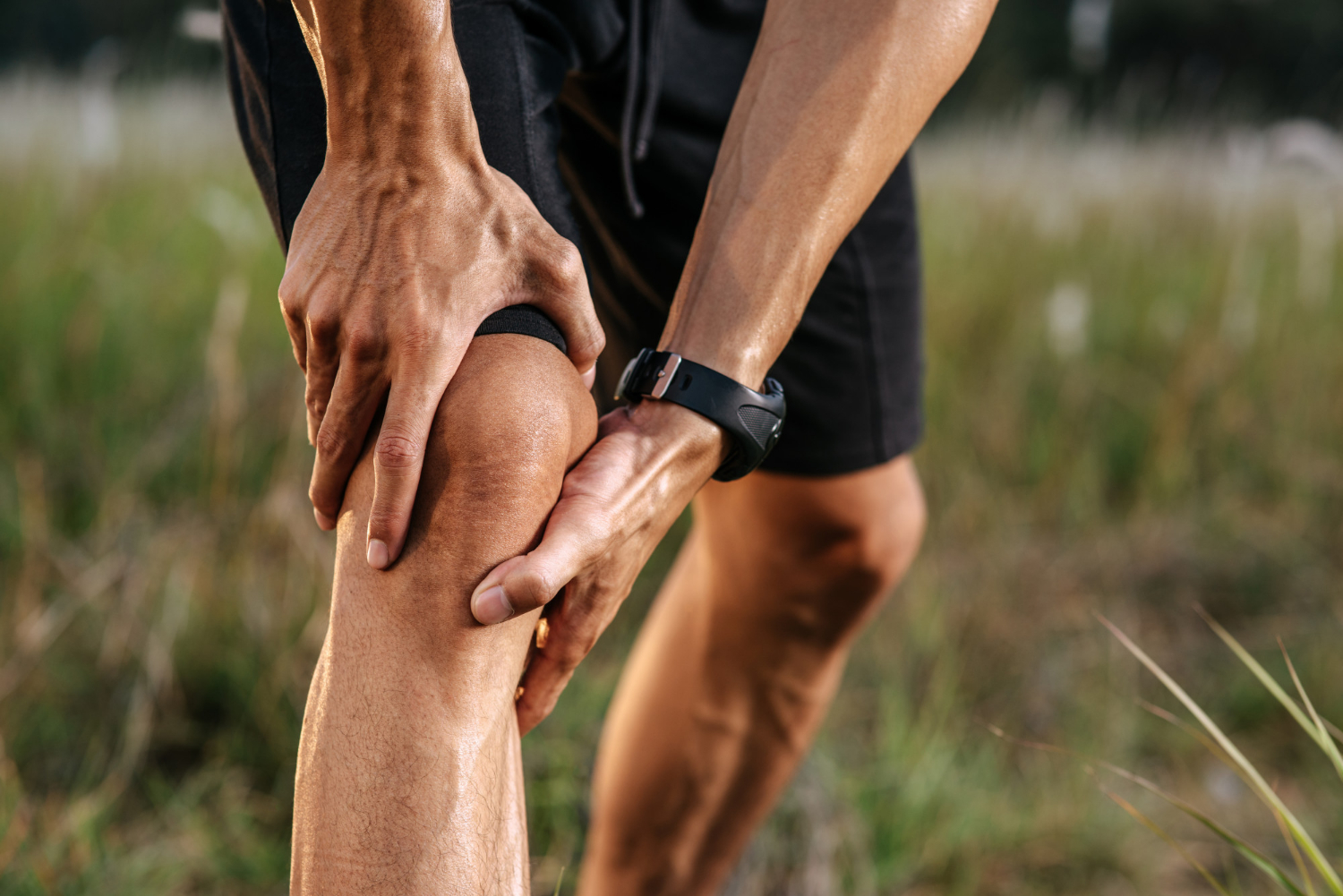
Knee pain can appear during a run, after a workout, or even the next day. Runners often describe a dull pain in front of or around the kneecap, discomfort when walking down stairs, running downhill, squatting, or after sitting for a long time with bent knees. Common running problems often include “runner’s knee” and iliotibial band syndrome, when pain is felt on the outer side of the knee.
Sometimes the pain gradually becomes stronger at a certain kilometre, while at other times it appears only after increasing distance or pace. If the discomfort makes you change your running technique, limp, or avoid putting weight on the leg, this is already a signal to reduce the workload.
Why does it happen?
One of the most common causes is overload: too many kilometres, increasing the pace too quickly, running on hills, or insufficient recovery. Many typical running injuries are associated with the principle of “too much, too soon,” meaning that the workload increases faster than the body can adapt.
Knee pain can also be affected by weak hip and glute muscles, insufficient core stability, technical errors, worn-out shoes, or running on uneven surfaces. In the case of runner’s knee, pain is more often felt in front of or around the kneecap, while with iliotibial band syndrome, it is felt on the outside of the knee, especially when running downhill or after several kilometres.
What should you do?
If your knee starts hurting during a run, reduce your pace, switch to walking, or finish the workout if the pain is getting worse. Running “through the pain” can make the problem worse, especially if you start changing your stride or shifting the load onto the other leg.
To reduce the risk of knee pain, you should:
- increase distance and pace gradually;
- temporarily remove downhill running, intervals, and other intense workouts;
- add strength exercises for the glutes, hips, and core muscles;
- check whether your running shoes are worn out;
- alternate running with recovery days;
- pay attention to your technique, especially if the pain keeps returning at the same distance.
If the pain is mild and quickly disappears after reducing the workload, your body may simply need a more gradual adaptation. But if your knee hurts for more than a few days, swells, clicks, gives way, hurts at rest, or makes walking difficult, it is better to consult a doctor or physical therapist. This can help identify the cause in time and prevent the situation from developing into a long break from running.
7. Lower Back Pain
What does it feel like?
During or after a run, you may experience an aching pain, spasm, or feeling of stiffness in the lower back. Sometimes the pain is felt on one side of the spine, and sometimes on both. It may become worse when turning the torso, bending, running downhill, or after prolonged sitting. Lower back pain can be related both to the back muscles and to insufficient strength, control, and stability in the lower back and pelvic area.
Why does it happen?
One common cause is tension or weakness in the muscles that are supposed to stabilize the core while running: the abdominal, back, glute, thigh, and hamstring muscles. If these muscles cannot handle the workload, the pelvis may tilt excessively forward, and the lower back takes on more work than it should. As a result, overload, spasm, or pain can occur.
Lower back pain can also be affected by prolonged sitting, weak glute muscles, insufficient hip mobility, tight hamstrings, and incorrect torso positioning while running. For runners, control in the lower back and pelvic area is especially important because instability in this area can contribute not only to localized back pain but also to other overuse injuries.
What should you do?
If your lower back starts hurting while running, reduce your pace, switch to walking, and check your body position: do not let your torso fall forward, do not excessively arch your lower back, relax your shoulders, and maintain natural movement. If the pain gets worse or changes your running technique, it is better to end the workout.
To reduce the risk of lower back pain, you should:
- add exercises for your core, back, glutes, and thighs;
- work on pelvic stability;
- do not ignore your warm-up before running;
- gradually increase distance and intensity;
- do gentle mobility exercises after prolonged sitting;
- pay attention to your posture while running, especially over long distances;
- do not run through pain if it gets worse with every kilometre.
In the case of muscular lower back pain, you should not remain completely inactive in bed for several days. If possible, maintain gentle activity, use heat, perform careful stretching after the acute phase, and gradually strengthen the abdominal, lower back, and glute muscles. If the pain keeps returning, does not disappear after rest, is accompanied by numbness or weakness, or radiates into the leg, it is better to consult a doctor or physical therapist.
Коли спорт потребує додаткового захисту?
When Does Sport Require Additional Protection?
Most running-related symptoms can be prevented or reduced through gradual increases in workload, proper footwear, warm-ups, recovery, and paying attention to the body’s signals. But sport always involves the risk of injury, and even experienced runners are not protected from falls, strains, overuse injuries, or sudden health problems.
This is exactly what the «Sport insurance» product from TAS life is designed for. It provides coverage specifically for the injuries and illnesses that most often occur during active sports, as well as additional medical services, online doctor consultations, and compensation for an ambulance call-out.
Such protection can help you return to an active life faster because, in the event of an injury or illness, you can focus on treatment that will be most effective rather than only on what you can afford with your own money at that particular moment.
You can learn more about the product and purchase it online via the link.
Run for the joy of it and stay healthy!